publications
publications by categories in reversed chronological order. generated by jekyll-scholar.
2026
-
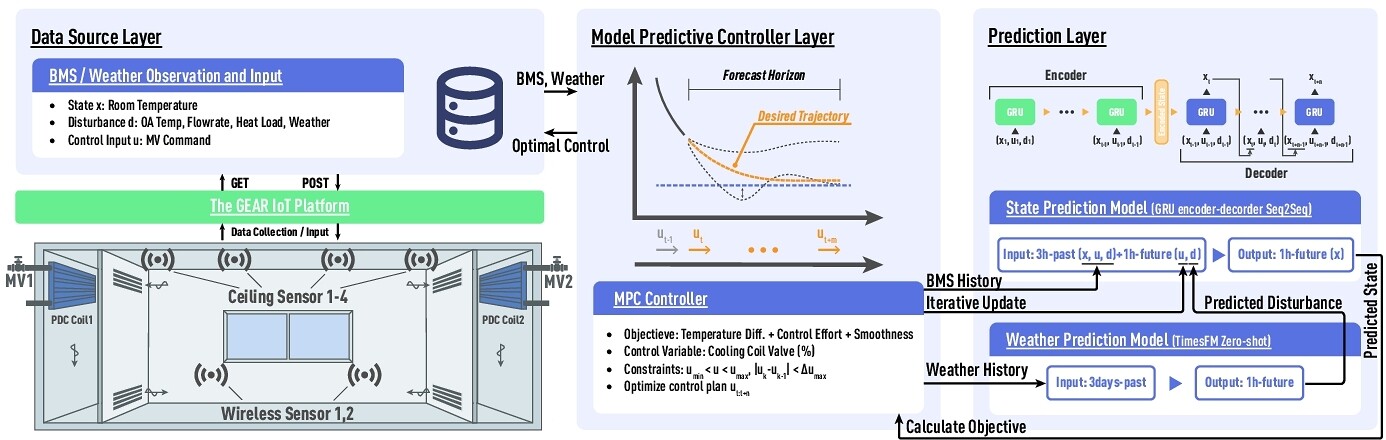 Toward a Practical AI-Enabled MPC Framework: A Case Study of a Passive Displacement Cooling SystemYutaka Shoji, Eikichi Ono, and Kuniaki MiharaIn Proceedings of the 2026 ACM Sustainability Week, , 2026
Learning-based model predictive control (MPC) is a promising approach for HVAC optimization, especially where slow thermal dynamics limit conventional control, yet end-to-end deployment on real-building IoT platforms remains rare. This paper presents a modular AI-enabled MPC framework comprising multi-step neural state prediction, forecast-aware constrained optimization, building management system integration, and periodic model updating from operational data. The framework is deployed on a cloud-based building IoT platform and validated on passive displacement cooling (PDC), where PI control is prone to overcooling. In paired-comparison experiments, the controller reduced mean maximum overcooling from (1.10 ,mathrm mathrm^circ mathrmmathrmC) to (0.20 ,mathrm mathrm^circ mathrmmathrmC) and mean settling time from 175 min to 40 min relative to PI control. Retraining with operational data further reduced the 60 min-ahead median prediction error from (0.33 ,mathrm mathrm^circ mathrm mathrmC) to (0.14 ,mathrm mathrm^circ mathrmmathrmC) while reducing closed-loop oscillation. Because the framework’s architecture is not specific to PDC, the same pipeline can be instantiated for other HVAC subsystems on the same platform by replacing the predictor training data and adjusting the MPC objective.
@inproceedings{10.1145/3765611.3815431,
  author = {Shoji, Yutaka and Ono, Eikichi and Mihara, Kuniaki},
  title = {Toward a Practical AI-Enabled MPC Framework: A Case Study of a
             Passive Displacement Cooling System},
  year = {2026},
  isbn = {9798400721991},
  publisher = {Association for Computing Machinery},
  address = {New York, NY, USA},
  url = {https://doi.org/10.1145/3765611.3815431},
  doi = {10.1145/3765611.3815431},
  booktitle = {Proceedings of the 2026 ACM Sustainability Week},
  pages = {291–295},
  numpages = {5},
  keywords = {Model Predictive Control, Building IoT Platform, HVAC Control,
                Encoder-Decoder Network},
  location = { },
  series = {ACM Sustainability Week '26},
}
2025
- CO-BUILD Smart Buildings Competition: An Empirical Comparison of HVAC Temperature Prediction ModelsSohei Arisaka, Eikichi Ono, HIROYASU MIURA, and 3 more authorsIn ICML 2025 CO-BUILD Workshop on Computational Optimization of Buildings, Jul 2025
@inproceedings{arisaka2025cobuild, title = {{CO}-{BUILD} Smart Buildings Competition: An Empirical Comparison of {HVAC} Temperature Prediction Models}, author = {Arisaka, Sohei and Ono, Eikichi and MIURA, HIROYASU and Shoji, Yutaka and Li, Yangayang and Mihara, Kuniaki}, booktitle = {ICML 2025 CO-BUILD Workshop on Computational Optimization of Buildings}, year = {2025}, month = jul, url = {https://openreview.net/forum?id=iX7osZTnU2}, } - Scalable Occupant-Centric HVAC Control in Accommodations Using Individual Preference and Global Thermal Comfort DatabaseEikichi Ono, Wataru Umishio, Kuniaki Mihara, and 3 more authorsIn ICML 2025 CO-BUILD Workshop on Computational Optimization of Buildings, Jul 2025
@inproceedings{ono2025scalable, title = {Scalable Occupant-Centric {HVAC} Control in Accommodations Using Individual Preference and Global Thermal Comfort Database}, author = {Ono, Eikichi and Umishio, Wataru and Mihara, Kuniaki and Shimo, Taizo and Shoji, Yutaka and OGAWA, KENJI}, booktitle = {ICML 2025 CO-BUILD Workshop on Computational Optimization of Buildings}, year = {2025}, month = jul, url = {https://openreview.net/forum?id=nQMA8Z5SjP}, } -
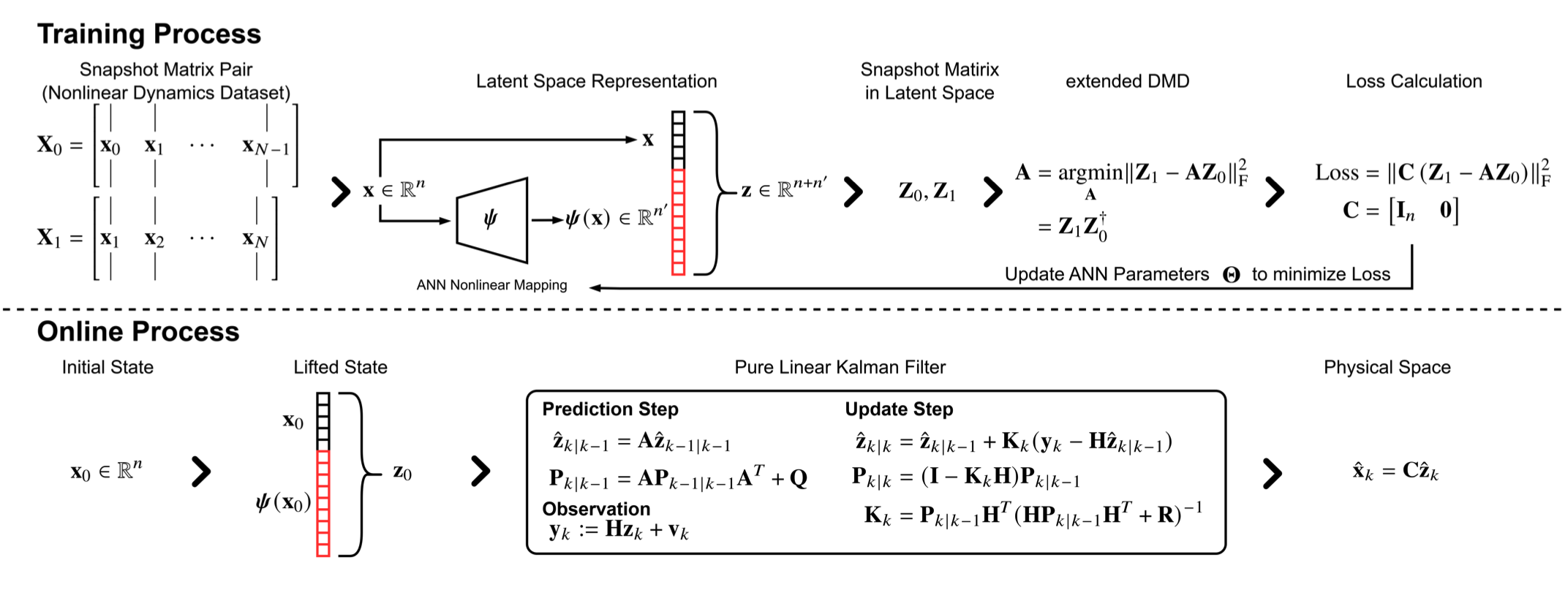 Poster Abstract: Data Assimilation for HVAC Simulations in Koopman-Invariant Subspace using Kalman FilterYutaka Shoji, Sohei Arisaka, Eikichi Ono, and 1 more authorIn Proceedings of the 12th ACM International Conference on Systems for Energy-Efficient Buildings, Cities, and Transportation, Colorado School of Mines, Golden, CO, USA, Nov 2025
Real-time state estimation in nonlinear HVAC dynamics requires computationally expensive nonlinear filtering methods. We present a data assimilation framework enabling standard linear Kalman filtering for nonlinear systems through Koopman operator theory. We transform nonlinear CFD simulations into linear dynamics using extended dynamic mode decomposition with neural network lifting functions. Our experiments demonstrate successful reconstruction of temperature and velocity fields from only 18 temperature sensors, achieving temperature RMSE of 0.16 °C and velocity RMSEs of 0.035 m/s and 0.031 m/s for u- and v-components respectively, notably inferring unobserved velocity fields solely from temperature measurements.
@inproceedings{10.1145/3736425.3772109,
  author = {Shoji, Yutaka and Arisaka, Sohei and Ono, Eikichi and Mihara, Kuniaki},
  title = {Poster Abstract: Data Assimilation for HVAC Simulations in
             Koopman-Invariant Subspace using Kalman Filter},
  year = {2025},
  month = nov,
  isbn = {9798400719455},
  publisher = {Association for Computing Machinery},
  address = {New York, NY, USA},
  url = {https://doi.org/10.1145/3736425.3772109},
  doi = {10.1145/3736425.3772109},
  booktitle = {Proceedings of the 12th ACM International Conference on Systems
                 for Energy-Efficient Buildings, Cities, and Transportation},
  pages = {306–307},
  numpages = {2},
  location = {Colorado School of Mines, Golden, CO, USA},
  series = {BuildSys '25},
}
2024
- Estimation of Multi-Layered Soil Thermal Properties using Data Assimilation MethodYutaka Shoji and Takao KatsuraIn Proceedings of ASim Conference 2024: 5th Asia Conference of IBPSA , Nov 2024
As global warming becomes a reality, the widespread adoption of shallow geothermal energy, known for its stability and ubiquity, is becoming increasingly important. The performance of shallow geothermal utilization depends heavily on soil thermal properties, such as the effective soil thermal conductivity and groundwater flow velocity. While methods for estimating effective soil thermal conductivity through thermal response tests are known, methods for estimating groundwater flow velocity have not been established. In this study, we propose a method to simultaneously estimate the vertical distribution of effective soil thermal conductivity, and the groundwater flow velocity by applying the Ensemble Kalman Filter (EnKF), a representative data assimilation method, to a ground heat exchanger model that considers multi-layered ground with groundwater flow. Numerical data assimilation experiment was performed on a quasi-3D borehole heat exchanger simulation with different soil effective thermal conductivities and groundwater flow velocities for each of three layers, using fluid temperature distributions in U-tubes as observed data. The results showed that the effective soil thermal conductivity and groundwater flow velocity can be estimated simultaneously by setting appropriate fluid heating conditions. This study proposed a method for estimating vertical thermophysical property distribution that takes into account the multi-layered nature of the ground. This method can be an important proposal to obtain more accurate simulation results for shallow geothermal applications in the presence of groundwater flow velocity.
@inproceedings{asim2024_1374,
  doi = {https://doi.org/10.69357/asim2024.1374},
  url = {https://publications.ibpsa.org/conference/paper/?id=asim2024_1374},
  year = {2024},
  month = nov,
  publisher = {IBPSA-Asia},
  author = {Shoji, Yutaka and Katsura, Takao},
  title = {Estimation of Multi-Layered Soil Thermal Properties using Data
             Assimilation Method},
  booktitle = {Proceedings of ASim Conference 2024: 5th Asia Conference of IBPSA
                 },
  volume = {5},
  isbn = {},
  address = {Osaka, Japan},
  series = {ASim Conference},
  pages = {1028--1035},
  issn = {},
  organisation = {IBPSA-Asia},
  editors = {},
}
2023
- Improvement of accuracy with uncertainty quantification in the simulation of a ground heat exchanger by combining model prediction and observationYutaka Shoji, Takao Katsura, and Katsunori NaganoGeothermics, 2023
With the utilization of shallow geothermal heat as a renewable energy source in recent times, several studies have focused on ground heat exchanger simulation. Ground heat exchanger simulation is an important factor that contributes to the design and control of shallow geothermal systems. Thus far, various models and parameter estimation methods have been proposed to represent actual phenomena; however, errors inevitably occur between the model predictions and actual values. Hence, a method that can explicitly account for this uncertainty is desirable. Thus, in this study, we show that data assimilation—a method that combines simulation and observation for more accurate state estimation and uncertainty quantification—can be applied to ground heat exchanger simulation. To this end, we perform an in situ transient heating experiment using a single-borehole heat exchanger, and we assimilate the actual observations using an ensemble Kalman filter for a reproductive simulation. The results of the data assimilation experiment indicate that the model parameter, i.e., the soil effective thermal conductivity, is modified from 1.19 W m−1 K−1 estimated from the geologic column to 1.70 ± 0.05 W m−1 K−1, and it reproduces the standard estimate of 1.69 W m−1 K−1 from the thermal response test. Further, for the ground heat exchanger inlet/outlet temperature, simulation without data assimilation yielded a maximum error of approximately 2.0 K, whereas simulation with data assimilation produced a highly accurate state estimate with a standard deviation of 0.08 K. The proposed method allows a posteriori estimation of soil properties from the operational data of ground heat exchanger systems installed without thermal response tests as well as the correction of deviations between the model and observation values through statistical support and uncertainty quantification.
@article{SHOJI2023102611,
  title = {Improvement of accuracy with uncertainty quantification in the
             simulation of a ground heat exchanger by combining model prediction
             and observation},
  journal = {Geothermics},
  volume = {107},
  pages = {102611},
  year = {2023},
  issn = {0375-6505},
  doi = {https://doi.org/10.1016/j.geothermics.2022.102611},
  url = {https://www.sciencedirect.com/science/article/pii/S0375650522002565},
  author = {Shoji, Yutaka and Katsura, Takao and Nagano, Katsunori},
  keywords = {Ground Heat Exchanger, Simulation, Parameter Estimation, Data
                Assimilation, Ensemble Kalman Filter},
}
2022
- MICS-ANN model: An artificial neural network model for fast computation of G-function in moving infinite cylindrical source modelYutaka Shoji, Takao Katsura, and Katsunori NaganoGeothermics, 2022
Model of the temperature field around the ground heat exchanger is a critical part of shallow geothermal system simulation. Some models have not yet obtained an analytical solution due to the presence of groundwater flow or the complex geometry of the ground heat exchanger. For such models, numerical analysis is performed and the computational cost is an issue. Here we show a method to reproduce the finite volume method solution of the moving infinite cylindrical source model quickly and accurately using an artificial neural network. Using the obtained artificial neural network model, the hourly 20-year temperature response function of the moving infinite cylindrical source model can be computed in only 5.726s. The mean squared error of the artificial neural network model for the finite volume method solution was 2.158×10⁻⁶ in dimensionless temperature, indicating a sufficiently small error. The fast and accurate calculation of the moving infinite cylindrical source model is expected to contribute to the optimal design of shallow geothermal systems with a groundwater flow field. In addition, this method of reproducing a temperature response function by artificial neural network may be applicable not only to the moving infinite cylindrical source model but also to other models.
@article{SHOJI2022102315, title = {MICS-ANN model: An artificial neural network model for fast computation of G-function in moving infinite cylindrical source model}, journal = {Geothermics}, volume = {100}, pages = {102315}, year = {2022}, issn = {0375-6505}, doi = {https://doi.org/10.1016/j.geothermics.2021.102315}, url = {https://www.sciencedirect.com/science/article/pii/S0375650521002704}, author = {Shoji, Yutaka and Katsura, Takao and Nagano, Katsunori}, keywords = {Ground heat exchanger, G-function, Artificial neural network, Machine learning, Groundwater flow, Moving infinite cylindrical source model}, } - Hybrid ground source heat pump system capable of year-round heating and its application in liquid natural gas vaporizationTakao Katsura, Yutaka Shoji, Kunning Yang, and 6 more authorsInternational Journal of Energy Research, 2022
Summary One of the challenges in using a ground source heat pump (GSHP) system is the long-term increase or decrease in underground temperature due to an imbalance between heat extraction and injection. To eliminate this imbalance, we proposed a hybrid GSHP (HGSHP) system combined with air–water heat exchangers (AWHEs) capable of year-round heating and applied it to the hot water supply for liquid natural gas (LNG) vaporization in a satellite station. In this paper, the authors demonstrate the year-round heating capability of the HGSHP system and the energy conservation benefits of installing the HGSHP system for LNG vaporization. First , a field experimental apparatus was constructed for a gas vaporization system with the HGSHP; thereafter, an experimental proof of gas vaporization was obtained. The experimental results showed that it was possible to stably vaporize liquid nitrogen that was used instead of LNG by supplying hot water at 25°C. Additionally, in the gas vaporization experiment with the HGSHP system in the summer season, the SCOP measured was over ten. A calculation model for the AWHE was then established using the field test data; thereafter, a simulation tool for the HGSHP system was developed by combining it with one for the GSHP system. The simulation results indicated that the average surface temperature of all GHEs in the HGSHP system decreases from first year to second year. However, the average surface temperature of all GHEs stabilizes at a reduced level after the third year. These results indicate that the HGSHP system can operate long-term for year-round heating because the average surface temperature stabilize in the long-term.
@article{https://doi.org/10.1002/er.8637, author = {Katsura, Takao and Shoji, Yutaka and Yang, Kunning and Akai, Hitoshi and Shishido, Jun and Ishikawa, Mitsuhiro and Yashima, Yuichi and Tanifuji, Koji and Nagano, Katsunori}, title = {Hybrid ground source heat pump system capable of year-round heating and its application in liquid natural gas vaporization}, journal = {International Journal of Energy Research}, volume = {46}, number = {15}, pages = {23388-23406}, keywords = {air–water heat exchanger, ground heat exchanger, hybrid ground source heat pump system, liquid natural gas vaporization, year-round heating}, doi = {https://doi.org/10.1002/er.8637}, url = {https://onlinelibrary.wiley.com/doi/abs/10.1002/er.8637}, year = {2022}, } - Improvement of Estimation Accuracy of Soil Effective Thermal Conductivity and Ground Heat Exchanger Simulation by Data Assimilation using Ensemble Kalman Filter.Yutaka Shoji, Takao Katsura, and Katsunori NaganoASHRAE Transactions, 2022
@article{shoji2022improvement,
  title = {Improvement of Estimation Accuracy of Soil Effective Thermal
             Conductivity and Ground Heat Exchanger Simulation by Data Assimilation
             using Ensemble Kalman Filter.},
  author = {Shoji, Yutaka and Katsura, Takao and Nagano, Katsunori},
  journal = {ASHRAE Transactions},
  volume = {128},
  year = {2022},
}
2020
- Method for calculation of ground temperature in scenario involving multiple ground heat exchangers considering groundwater advectionTakao Katsura, Yutaka Shoji, Yoshitaka Sakata, and 1 more authorEnergy and Buildings, 2020
The calculation of the ground temperature considering groundwater advection is one of the most noteworthy challenges for the simulation and design of a shallow geothermal system. This paper proposes a new method to calculate the temperature considering the groundwater advection in a scenario involving multiple ground heat exchangers and the time-variable heat flux condition. The superposition principle of the moving infinite cylindrical source solution and the moving infinite line source solution was applied in combination. Furthermore, a regression analysis was performed for various numerical calculation results obtained using a moving infinite cylindrical source model, and a simple and fast calculation solution for the problem was established. The proposed method demonstrated a maximum error of 0.0879 for the dimensionless temperature compared with the numerical calculation result.
@article{KATSURA2020110000, title = {Method for calculation of ground temperature in scenario involving multiple ground heat exchangers considering groundwater advection}, journal = {Energy and Buildings}, volume = {220}, pages = {110000}, year = {2020}, issn = {0378-7788}, doi = {https://doi.org/10.1016/j.enbuild.2020.110000}, url = {https://www.sciencedirect.com/science/article/pii/S0378778819336564}, author = {Katsura, Takao and Shoji, Yutaka and Sakata, Yoshitaka and Nagano, Katsunori}, keywords = {Ground heat exchanger, Moving infinite cylindrical source, Moving infinite line source, Principle of superposition}, } - Fast Convolution in Calculation of Soil Temperature surrounding Ground Heat Exchangers with GPGPUYutaka SHOJI, Takao KATSURA, Yoshitaka SAKATA, and 1 more authorTransactions of the Japan Society of Refrigerating and Air Conditioning Engineers, 2020
@article{SHOJI202020-26TN_EM_OA, title = {Fast Convolution in Calculation of Soil Temperature surrounding Ground Heat Exchangers with GPGPU}, author = {SHOJI, Yutaka and KATSURA, Takao and SAKATA, Yoshitaka and NAGANO, Katsunori}, journal = {Transactions of the Japan Society of Refrigerating and Air Conditioning Engineers}, volume = {37}, number = {3}, pages = {313}, year = {2020}, doi = {10.11322/tjsrae.20-26TN_EM_OA}, } - 人工ニューラルネットワークによる回帰モデルを用いた地下水流れを伴う地中熱交換器周囲温度応答関数の計算手法優陸 小司, 隆生 葛, 義隆 阪田, and 1 more author空気調和・衛生工学会 論文集, 2020
@article{YutakaShoji2020,
  title = {人工ニューラルネットワークによる回帰モデルを用いた地下水流れを伴う地中熱交換器周囲温度応答関数の計算手法},
  author = {小司, 優陸 and 葛, 隆生 and 阪田, 義隆 and 長野, 克則},
  journal = {空気調和・衛生工学会 論文集},
  volume = {45},
  number = {279},
  pages = {11-18},
  year = {2020},
  doi = {10.18948/shase.45.279_11},
}
2018
- Development and verification of control system for heat recovery ground source heat pump systemTakao Katsura, Yutaka Shoji, Yoshiki Miyashita, and 2 more authors2018
@article{katsura2018development, title = {Development and verification of control system for heat recovery ground source heat pump system}, author = {Katsura, Takao and Shoji, Yutaka and Miyashita, Yoshiki and Nagano, Katsunori and Nakamura, Yasushi}, year = {2018}, publisher = {International Ground Source Heat Pump Association}, doi = {10.22488/okstate.18.000030}, } - Design and simulation tool for ground source heat pump systems considering groundwater advectionYutaka Shoji, Takao Katsura, Takashi Higashitani, and 2 more authors2018
@article{shoji2018design,
  title = {Design and simulation tool for ground source heat pump systems
             considering groundwater advection},
  author = {Shoji, Yutaka and Katsura, Takao and Higashitani, Takashi and Nagano, Katsunori and Sakata, Yoshitaka},
  year = {2018},
  publisher = {International Ground Source Heat Pump Association},
  doi = {10.22488/okstate.18.000046},
}